Fighting for a new balance of power in the world
Vijay Prashad: ‘The West is an unreliable partner for the Global South’
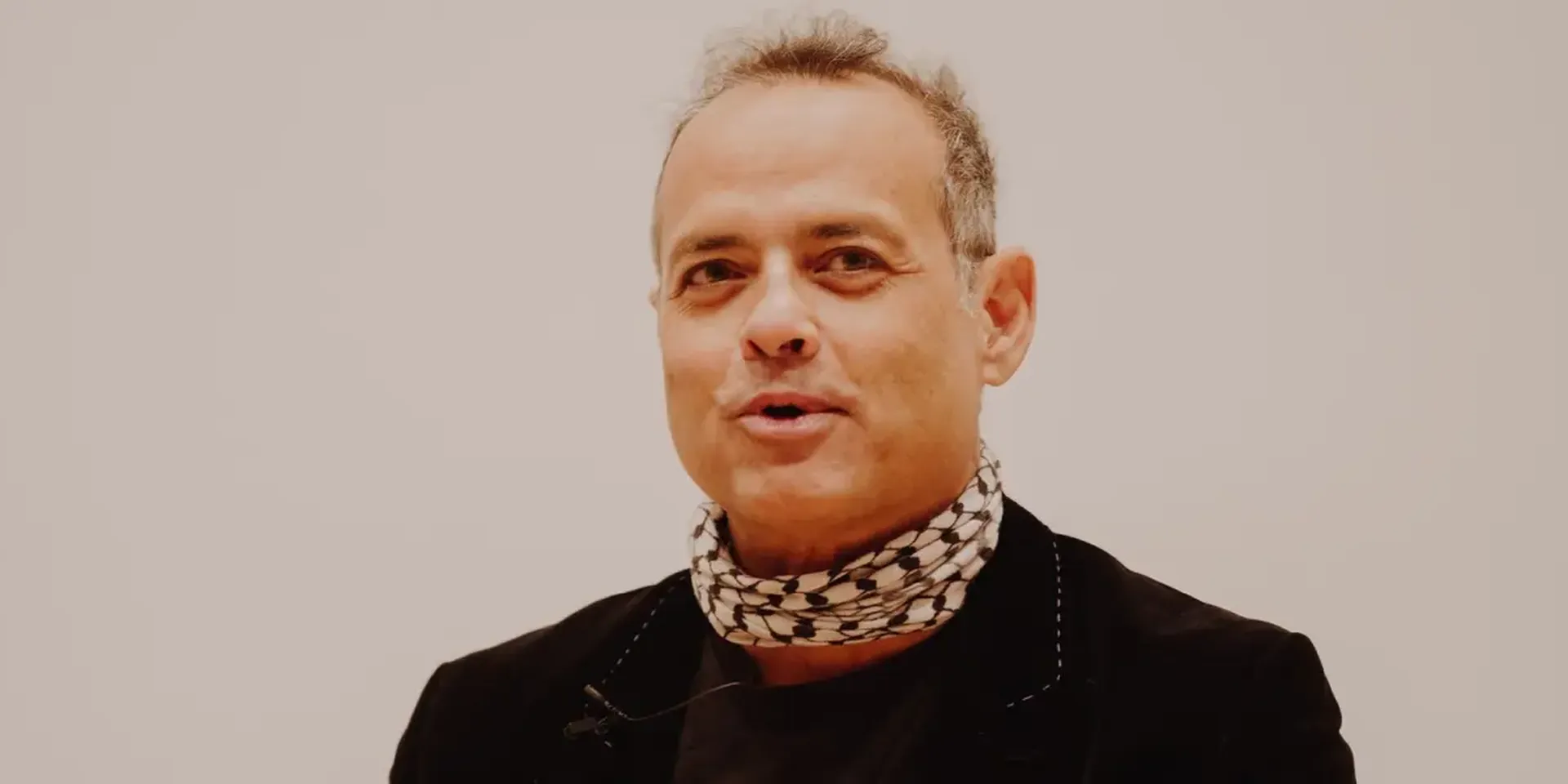
© Diederik De Mezel
© Diederik De Mezel

With the United States unpacking unashamed imperialism, it is important even for European countries to learn from the Global South’s decades-long struggle for self-determination. A conversation with Vijay Prashad, on lessons from the decolonisation struggle and global opportunities anno 2026.
This article was translated from Dutch by kompreno, which provides high-quality, distraction-free journalism in five languages. Partner of the European Press Prize, kompreno curates top stories from 30+ sources across 15 European countries. Join here to support independent journalism.
‘I am a revolutionary’, says Vijay Prashad in the middle of the conversation, ‘but not the kind who stands on a soapbox and decrees what needs to be done. That is revolutionary arrogance. On the contrary, you have to analyse very carefully what the world really looks like and how it is evolving. Then you can try to exert maximum influence within that framework.’ His analyses are well-founded, but the soapbox is never far away. Because a convincing story can change reality.
‘Vijay Prashad is one of India’s most important writers, journalists and historians’, says the website of EPO, the publisher of his book Imperialism for Beginners, among others. Publishers are naturally inclined to exaggerate the importance of their authors, but this statement is completely unfounded. The website of Tricontinental – Institute for Social Research, the think tank of which he himself is the director, sounds more sober: ‘Vijay is an Indian historian and journalist.’
To be clear, Prashad is indeed a leading voice in the global debate on decolonisation and just international relations. He has written forty books (including some with Noam Chomsky), runs Tricontinental, writes for the news platform Globetrotter, and is the publisher of LeftWord Books. Tricontinental has its headquarters in Northampton, Massachusetts, and offices in India, Brazil, South Africa and Argentina. LeftWord publishes from New Delhi, Vijay himself lives in Chile and in early December he spoke at five Belgian universities.
In other words, Vijay Prashad is every inch a global citizen. A left-wing global citizen whose view of history and current political affairs is based not on the Western canon but on the interests of the Global South. His limited influence in India is due to the loss of impact of left-wing and communist parties, but also to active repression. The courts suspect him of fraudulent financing of the Indian news site Newsclick, which is also accused of being a propaganda channel for China. As a result, Prashad has not even been able to return to his native country for the past five years.
Gie Goris spoke with Vijay Prashad in December. The interview below is based on the public conversation the two had at the VUB, announced under the title From Bandung to Gaza, and on a supplementary interview afterwards. We therefore begin the conversation in the Indonesian city of Bandung, where the historic gathering of newly independent nations and liberation movements from Africa, the Middle East and Asia took place in April 1955.
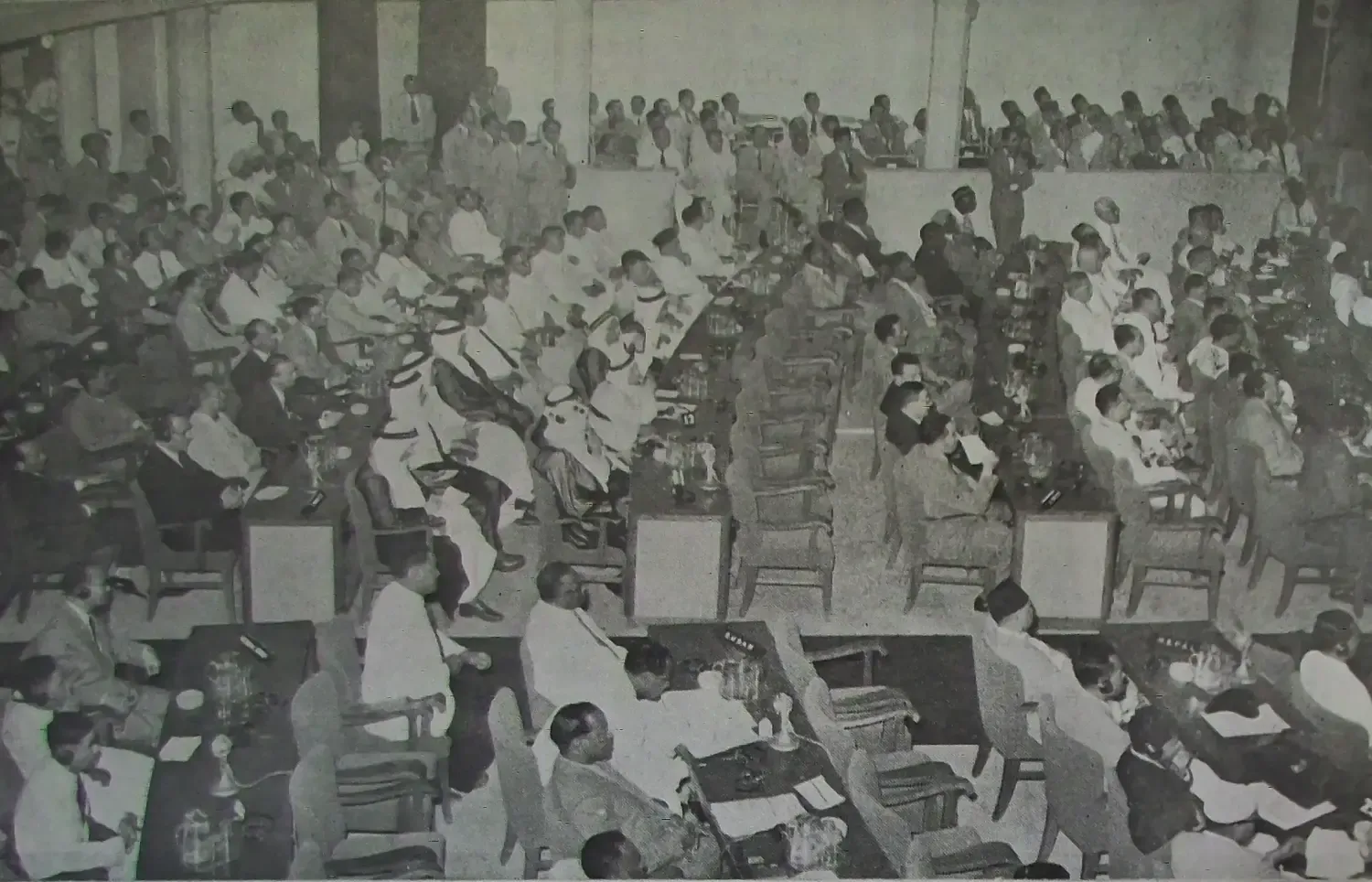
‘In Bandung, no borders were drawn or territorial agreements made, but new dynamics were unleashed, across national borders,’ writes David Van Reybrouck in his monumental work on the Indonesian struggle for independence.

In Revolusi, his monumental book about the Indonesian struggle for independence, David Van Reybrouck describes the Bandung conference as a historic turning point: ‘No borders were drawn or territorial agreements made here, but new dynamics were unleashed, across national borders. It was this dynamic that gave Egypt the courage to challenge Great Britain and appropriate the Suez Canal. Bandung convinced German and French leaders that European countries had to unite “if Europe did not want to be crushed by the peoples of Asia and Africa in the near future”. It was Bandung that fuelled the pan-African thinking and quest for independence of Patrice Lumumba, among others, and that inspired both Malcolm X and Martin Luther King in the United States to take action for equal civil rights.’
Vijay Prashad: ‘Bandung stands for more than the 1955 conference. When you say “Bandung”, you are actually saying: “The South has its own ideas”. The West continues to see itself as the source of ideas, while the South mainly produces rebels. Yet those leaders from Asia, Africa and Latin America were also thinkers. But who ever reads the speech Che Guevara gave in Algiers in 1965 about the global economy? Who knows Ho Chi Minh’s work on the need to follow the good (patriotic) example and on the moral responsibility towards fellow human beings?’
Perhaps Europeans are unfamiliar with this body of thought and fail to recognise the philosophical contribution of the Global South. But the participants at the Bandung conference were well aware of it. They knew that national liberation and anti-colonial struggles were preceded by decades of intellectual emancipation. What made the meeting so special for them?
Vijay Prashad: ‘The essence had already been formulated two hundred years earlier by Simon Bolivar: the need for a new balance in the world. That was the underlying motivation of generations of anti-colonial struggle. That was what drove Lumumba and the movement for national independence in Congo: the demand to establish a new balance in the international order, in which peoples from the South could also govern their own nations.’
‘In addition, conferences such as the one in Bandung created a space where these leaders and thinkers could engage in dialogue. This was also true of the first congress of the International League Against Imperialism and Colonial Oppression in Brussels in 1927, and of the Summit Conference in Belgrade in 1964, where the Non-Aligned Movement was founded.’
‘The future Indian Prime Minister Nehru and Indonesian President Sukarno met for the first time in Brussels in 1927. These meetings were opportunities to learn from each other’s experiences and strategies. This also resulted in concrete cooperation, including Indian support for the Chinese struggle as early as the 1930s. The ties between the Indian and Chinese struggles even go back to Tagore’s visit to China in 1910.
The Indians were repaid for that solidarity in 1961, when China annexed part of Jammu & Kashmir and waged a short war against Nehru’s India.
Vijay Prashad: ‘South-South cooperation is not a given or a fixed reality either. Rather, it is something we must work towards and strive for.’
Bandung took place against the dual backdrop of the end of European colonial rule of the world on the one hand and the new division of the world during the Cold War on the other. The Non-Aligned Movement, with its Third World project, wanted to stay out of the new power competition. But did the project survive the end of the Cold War?
Vijay Prashad: ‘Seventy years after Bandung, the fight for our own ideas and solutions is just as relevant as it was then. Take Gaza. The Palestinians are really not interested in Western ideas for the future. Whether we believe in a two-state solution or not is less important than what they themselves think about it. What we can do is create the conditions for them to realise their own solutions. We must fight for the release of political prisoners, such as Marwan Barghouti, who has been behind bars for 23.5 years, or Ahmad Saadat. Because they can take the lead in political negotiations.’
‘The “spirit of Bandung” suffered with the end of the Soviet Union, but the actual defeat of the Third World took place a little less than a decade earlier: with the debt crisis that broke out in Mexico in 1982. It was not that the enormous threat of loans and debts had not been foreseen. In 1965, one of the pioneers of the pan-African movement, President Kwame Nkrumah of Ghana, wrote the book Neo-colonialism: The Last Stage of Imperialism. Nkrumah’s basic premise was that the Europeans first came to exploit and steal Africa’s wealth, then gave independence to the impoverished nations, and then provided development loans, creating a new dependency.’
‘What that really meant became clear after 1982, when the International Monetary Fund brought one country after another in the Global South to its knees. Worse still, the Global South’s self-confidence disappeared. Leaders once again looked to Washington for solutions instead of to their own strength and to each other.’
The debt crisis and the structural adjustment programmes imposed at that time were perhaps even worse for the development prospects of the Global South than the colonial legacy they had shaken off during the Bandung period?
Vijay Prashad: ‘In early 2026, I will publish a book with Zambian economist Grieve Chelwa entitled How the IMF Has Suffocated Africa. So yes, the structural adjustment programmes – with their privatisations, government cutbacks and belief in international markets – were disastrous. This almost religious IMF ideology is dangerously supported by NGOs such as Transparency International, which only point the finger at corruption within the public sector, while the role of multinational mining companies, for example, remains completely out of the picture – even though they are the ones fuelling corruption, siphoning off profits and “buying” politicians.’
‘Yet the defeat of the South has not proved insurmountable. Namibia is a good example of this. When that country in southern Africa was a German colony, the Germans committed their first genocide there against the Herero and Nama, thirty years before the Holocaust.’
‘After a struggle for independence against the South African apartheid regime, Namibia became an independent country, but in the 1990s, the liberation movement SWAPO also had to bow to the dictates of the IMF. Pride was left behind, the national project broken. But in 2022, it is back in full force. At the Munich Security Conference, Namibia’s prime minister was attacked by a German attendee because Namibia did not condemn Russia’s invasion of Ukraine. Saara Kuugongelwa-Amadhila responded that “it was not her war” and, moreover, that her liberation struggle had always been fully supported by the Soviet Union, while Europe supported South Africa.’
‘Where did she get the confidence to put Germany, Europe and the West so firmly in their place? Namibia was not suddenly free of debt, but it was freed from its unilateral dependence on Western-controlled institutions. Today, African countries can also turn to institutions such as the New Development Bank and other Chinese-funded institutions from the Global South. If the Federal Reserve in the US is being difficult, they simply go to Beijing and talk to the People’s Bank of China. This proves that even in the 1980s and 1990s, the spirit of Bandung was not dead, but merely shelved, waiting for better times.’
The New Development Bank is not purely a Chinese initiative, but arose in the context of BRICS. Is BRICS+ the Global South’s answer to the neo-colonial dominance of the West?
Vijay Prashad: ‘It is not about a single platform, but about a more fundamental shift. And the moment when the minds in the Global South made that shift was the financial crisis of 2008. It then became clear that their growing exports could not rely solely on the sputtering and stagnating European markets. This explains the almost desperate shift within BRICS in 2009, with all kinds of initiatives being set up to facilitate, stimulate and accelerate South-South trade. Since then, we have seen the Chinese Belt and Road Initiative (better known as the new Silk Roads), the revival of the Shanghai Cooperation Organisation, the RCEP free trade zone with 15 countries in the Asia-Pacific region...’
What is the tangible result of seven decades of anti-colonial struggle and international solidarity?
Vijay Prashad: ‘The recognition that countries have a right to independence and sovereignty is no small achievement. How fragile that achievement still is, even in 2025, is demonstrated by the matter-of-factness with which Tony Blair is seen as the new viceroy for Gaza. Another achievement is democracy in countries after colonial rule. That democracy applied immediately and without discussion to women, the extremely poor and illiterate, oppressed minorities, to everyone.’
That sounds like the answer you would give in 1955 or 1965. Have there been no new results since then from the struggle for independence, self-government and development?
Vijay Prashad: ‘That second phase must revolve around the benefits that independence brings to the poor. Economic growth must be used to build schools and hospitals and to give the poor access to those public facilities. That was Kwame Nkrumah’s vision of sovereignty, and also Hugo Chavez’s: the wealth of the country and its subsoil belongs to the people, not to multinational companies. That is why Indonesia refuses to export its raw nickel, and therefore demands that it be processed in its own country.’
A striking observation is that Russia is now apparently considered part of the Global South, even though it has a long history of colonial conquest in Central Asia and occupation in Eastern Europe, and continues to pursue a form of imperialist policy even after the collapse of the Soviet Union.
Vijay Prashad: ‘That certainly has to do with the historical experience with the Soviet Union. Nehru visited Russia in 1927 and wrote an important book about it, in which he advocates a similar revolution in India. Even historians are mistaken when they think that Woodrow Wilson’s 14-point speech in 1918 was the starting point for the national liberation movements, whereas Lenin’s writings on the self-determination of peoples were much more influential.’
‘Lenin really saw the Tsarist regime as an imperial power, which is why large parts of the Russian Empire were given the status of autonomous republics after the revolution. Moreover, most countries in the South see Russia as an Asian nation rather than a European one, even though the Russians see themselves as Europeans. Russia has made attempts to become part of the imperialist structure in the world, including by joining the G8. Since being thrown out of that structure again, Russia has increasingly presented itself as part of the developing world, as an emerging nation rather than part of the dominant world.’
Not only was Russia kicked out of the G8, but since the war of aggression against Ukraine, it has also been subject to Western sanctions.
Vijay Prashad: ‘The West has made a big mistake by increasingly resorting to economic sanctions. In particular, the 2012 decision to ban Iran from the Swift international payment system came as a stark warning to the entire Global South. Suddenly, there was a growing realisation that the Global South had to build its own systems, because otherwise it would always remain dependent on Europe’s political approval. The West is unreliable. In the event of a conflict, it is willing to confiscate other states’ money or exclude countries from the world market.’
‘The West has politicised the economy and world trade. That is a mistake, as even the Communist Party of China knows. World trade and development should not be dependent on the political preferences of the West.’
No united bloc
The Global South, as a concept, suggests a coherent bloc, a shared vision and common interests. But if we look at Gaza, for example, we see that the Arab countries are enthusiastically cooperating with Trump’s “peace proposals”, but doing little to stop Israel.
Vijay Prashad: ‘The attitude of countries such as Jordan and Egypt is simply shameful. The Jordanian queen, who is of Palestinian descent, gave good interviews, but the king did nothing. He did not threaten to terminate the 1948 agreement between Israel and Jordan if the bombings did not stop. The Egyptian army, with all its F-16s, refused to act.’
‘Throughout the Arab world, you can see that pan-Arab nationalism has lost out to the conservative Saudi royal family. You can see that in Palestine too. The pan-Arabists are behind Israeli bars, while the Muslim Brotherhood is present on the ground. That is no coincidence, and it plays into the hands of Israeli and Western interests in the Middle East.’
Not everything is running smoothly within BRICS either. For example, little progress has been made in reducing dependence on the dollar for international trade. Can BRICS build a real alternative? And if BRICS becomes stronger, will the least developed countries ever benefit from it?
Vijay Prashad: ‘I think the importance of the de-dollarisation of the economy is overrated. The vast majority of all economic activity takes place within countries, and you don’t need dollars for that. Even half of international trade is conducted in national currencies. India and Russia trade in rupees and roubles, China and Russia use yuan and roubles. It is the other fifty per cent that makes an international currency necessary, because it mainly concerns oil and the enormous trade surpluses that oil-producing countries have.’
‘But the question of inequality within the Global South is much more essential. In 1990, the South Commission, a group of 28 prominent individuals from the South chaired by Julius Nyerere, published a report entitled The Challenge to the South. Among other things, this was a response to the 1980 Brandt Report, in which the Commission on International Development Issues defined the inequality between North and South as a central problem. The South Commission argued that it was not just a question of inequality in wealth, but also of an imbalance of power.’
‘As a solution to this combined problem, the report proposed that the strongest economies in the South should function as locomotives to which the other countries could attach their economies in order to gain speed.’
Metaphors are tempting but also misleading. Neoliberal globalisation was sold with the image: let the water rise, because it will lift both large and small boats. That did not work, because the rising water turned out to be a storm and the fishing boats capsized, while the warships became even more powerful. Why should we believe that the locomotives from the South will pull the poorest countries along?
Vijay Prashad: ‘The Chinese president always makes his first foreign visit of the year to an African country. This has been a regular practice since the 1960s. Just because the Western press does not write about it does not mean it is not relevant. In 2000, the Forum on China-Africa Cooperation was established, bringing together China, the African Union and 53 African countries.’
‘The FOCAC also meets at the beginning of each year. In recent years, China has made it clear at this Forum that the way trade is conducted is causing excessive trade surpluses and, as a result, increasing instability, including in China. This benefits no one. That is why China wants to invest in strengthening the processing industry in Africa, so that African countries no longer have to export only raw materials, but can also realise part of the added value in their own countries.’
‘However, it will be a long time before this train really gets going. National development plans are needed for this. This presupposes that the state and relevant capacity will be rebuilt. Everything that disappeared under the IMF’s wrecking ball must be rebuilt. The financial infrastructure of these nations must be rebuilt, from ministries and national banks to a kind of African Central Bank. That takes time. China is now willing to transfer knowledge and technology, a bit like Japan did for China in the early days of its reforms. These are real processes, in the material world. We have to work with that.’
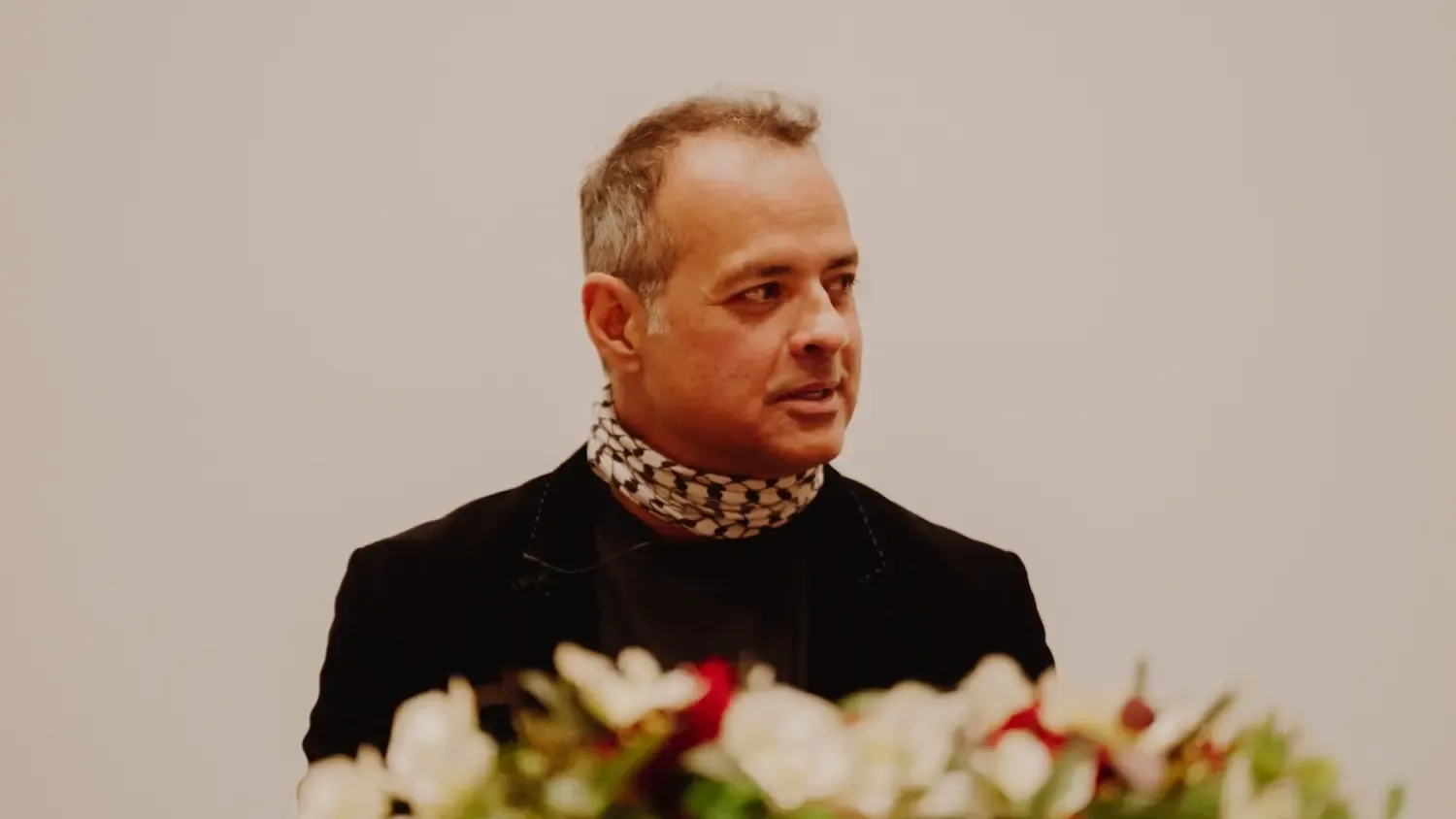
The Palestinian pan-Arabists are behind Israeli bars, the Muslim Brotherhood is present on the ground. That is no coincidence, and it plays into the hands of the interests of Israel and Western powers in the Middle East.
© Diederik De Mezel
The return of the US?
Make America Great Again is also real and increasingly material. Do you see Trump and his MAGA as the return of the United States as the dominant superpower, or is it rather a chaotic and tragic end to the long American century?
Vijay Prashad: ‘It is certainly not the latter. Every “end” is a new beginning, and so American power will not disappear quickly – it will rather take on new forms. You saw that even after the defeat of Nazi Germany, when old Nazis in Germany, but also in Chile, were given new positions and opportunities.’
‘MAGA itself is, incidentally, the result of previous policies. For that, too, we have to go back to the 1980s, when government and social security were dismantled, while tax havens flourished. Social democrats then used the weapon of austerity to shoot themselves in the foot. Entire societies were brutalised, and what you see now is the reaction to that.’
‘MAGA relies on the brutalised masses who reject the elite. It is not a project for the future, but political violence in response to social violence. The only way to undo this is to rebuild a society that functions not only for the elite, but also for workers. It is therefore tragic that social democrats are not working on this.’
Why do you use the contrast between the population and the elite, when that is exactly the language used by the far right and MAGA? I would expect a Marxist to at least talk about the rich and the poor, or about workers and capitalists?
Vijay Prashad: ‘It is true that we have to be careful with our vocabulary. Although you cannot just invent a new vocabulary. Academics sometimes have that tendency. Our vocabulary must come from reality, from the struggles that people are fighting. In that sense, it is indeed better to talk about rich and poor. Although I also find elite useful, because it contains “elitist”, and many people who are rich or powerful do indeed find themselves in a different universe, from where they look down on the rest of humanity.’
Just as the West looks down on the peoples of the South. Meanwhile, Western support for Israel has destroyed the credibility of the values and world order that Europe has always advocated. Are we losing universal human rights at a time when they are needed more than ever?
Vijay Prashad: ‘I don’t think Western support for Israel undermines universal human rights itself. This isn’t the first time, by the way. After Guantanamo, the illegal invasion of Iraq, Abu Ghraib and American torture chambers in Poland and elsewhere, the United Nations was mobilised and an agreement called Responsibility to Protect was reached.’
‘Human rights and internationalism did not disappear; they were strengthened. Even after the US and NATO abused R2P for regime change in Libya, international cooperation and multilateralism were revived. The real problem is that the collective West still dominates and controls the global information system. When the major Anglo-Saxon media write that human rights are passé, the whole world repeats it. Still.’
Koenraad Boogaert of Ghent University argues that the credibility of universal human rights is fundamental because social movements use that language to fight their battles and justify their actions.
Vijay Prashad: ‘Of course you had to hold on to and defend the universality of human rights with both hands. It starts with the treaty obligations that all UN countries have to recognise and realise human rights. It is sometimes a bit complicated, because some countries in the Global South do rightly stand up for their sovereignty, but not necessarily for universal and equal rights and dignity for all their citizens. Iran is one such example. Russia too.’
‘Those who abandon the language of human rights also distance themselves from the pursuit of socialism. Because the right to development is also part of the human rights discourse – and attempts are still being made to make that right a treaty right. This is constantly being blocked by the US, but the struggle continues. We must continue to stand up for good and universal healthcare, for decent housing for all, for dignified work. These are human rights.’
The real debate
In the whole debate on anti-colonialism or anti-imperialism, a great deal of attention is paid to political and economic sovereignty, but remarkably little is said about the ecological concerns of the Global South or the ecological responsibility of the North.
Vijay Prashad: ‘It’s not that it’s not being talked or written about. In the run-up to the COP in Belem, Tricontinental’s Brazilian team published an excellent analysis of the climate crisis as a crisis of capitalism, with a particular focus on the energy issue and how it relates to development. If you don’t make those connections, it becomes a desperate debate about dying species, destroyed biodiversity and runaway global warming.’
‘Incidentally, while everyone was following the Climate Summit in Brazil, another international meeting was taking place in Nairobi that was not reported on, but which could have greater consequences for climate and climate justice.’
‘At the meeting of the Intergovernmental Negotiating Committee on the UN Framework Convention on International Tax Cooperation, proposals were discussed to combat tax evasion or avoidance and give countries in the Global South more control over the profits generated on their territory. The proposal to levy an additional tax on CO2 polluters was rejected by the EU and the US. Meanwhile, the EU did have its say in Belém. The contrast between these two simultaneous but conflicting positions is an ecological debate that could make a real difference.’
Nevertheless, the necessary development and increase in prosperity in the Global South in 2015 can no longer ignore the ecological consequences and planetary boundaries.
Vijay Prashad: ‘I completely agree. But neither can you forget the primary responsibility of the Global North. A study by Brown University has already made it clear that the US military is the largest institutional CO2 polluter in the world. And now the European NATO member states have promised to spend 5 per cent of their GDP on military expenditure.’
‘According to Scientists for Global Responsibility, a $100 billion increase in military spending will result in an average increase of 32 million tonnes of CO2 emissions. If you take the raw figures, you get an idea of what the promised increase in defence budgets by 2035 means in terms of CO2 emissions. Last year, NATO member states collectively spent approximately $1.15 trillion on defence. If all member states reach 5 per cent, that will amount to $2.54 trillion.’
‘On a linear basis, that increase would result in an additional 365 million tonnes of CO2 – almost as much as the total annual emissions of countries such as Italy or the United Kingdom. In other words, the problem is not your individual footprint, but defence emissions!
 This article was translated from Dutch by kompreno, which provides high-quality, distraction-free journalism in five languages. Partner of the European Press Prize, kompreno curates top stories from 30+ sources across 15 European countries. Join here to support independent journalism.
The translation is AI-assisted. The original article remains the final version. Despite our efforts to ensure accuracy, some nuances of the original text may not be fully reproduced.
Lees ook
Ontvang het beste van MO* rechtstreeks in je mailbox
Schrijf je nu in op onze gratis nieuwsbrieven en wij houden je op de hoogte van wat er gaande is in onze mondialiserende en snel veranderende wereld.
If you are proMO*...
Most of our work is published in Dutch, as a proMO* you will receive mainly Dutch content. That said we are constantly working to improve our translated work. You are always welcome to support us both as a proMO* or by supporting us with a donation. Want to know more? Contact us at promo@mo.be.
You help us grow and ensure that we can spread all our stories for free. You receive MO*Magazine and extra editions four times a year.
You are welcome at our events free of charge and have a chance to win free tickets for concerts, films, festivals and exhibitions.
You can enter into a dialogue with our journalists via a separate Facebook group.
Every month you receive a newsletter with a look behind the scenes.
You follow the authors and topics that interest you and you can keep the best articles for later.
Per month
€4,60
Pay monthly through domiciliation.
Meest gekozen
Per year
€60
Pay annually through domiciliation.
For a year
€65
Pay for one year.
Are you already proMO*
Then log in here